August 06, 2025
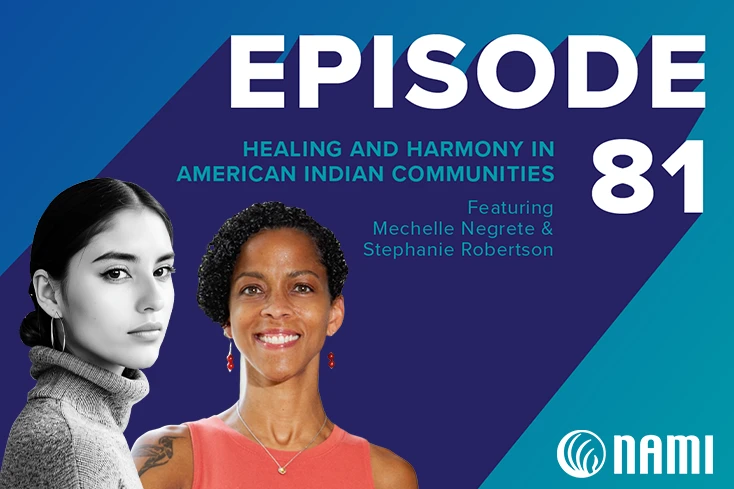
This episode is part of NAMI’s recognition of International Day of the World’s Indigenous Peoples on Saturday, August 9. In this episode, guest host Stephanie Robertson, Director of Mental Health Equity Innovation, is joined by Mechelle Negrete, NAMI’s Manager of American Indian Mental Health Community Outreach. They discuss their experiences with mental health, how they became mental health advocates, barriers to care for American Indian communities, what change they hope to see, and more.
You can find additional episodes of this NAMI podcast and others at nami.org/podcast.
We hope this podcast encourages you, inspires you, helps you and brings you further into the collective to know: you are not alone.
Episodes will air every other Wednesday and will be available on most major directories and apps.

Mechelle Negrete (she/her) is the Manager of American Indian Community Outreach for NAMI’s Cross-Cultural Innovation and Engagement team. Mechelle’s academic and professional work spans museum operations, language documentation, and public health projects. With 10 years of experience in the non-profit environment, coupled with her cultural background as Mescalero Apache, Mechelle has been supporting the expansion of the Sharing Hope Series into native communities.
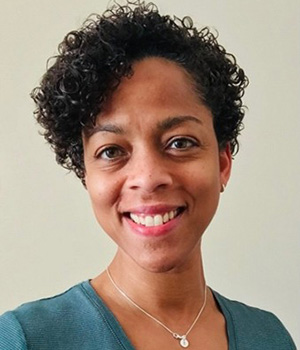
Stephanie Robertson is NAMI’s new Director of Mental Health Equity Innovation and will be leading efforts to address disparities in mental health care, with a focus on Black/African Ancestry communities. She will oversee the Community Health Equity Alliance and develop strategies to expand access to care for minoritized groups.
A Duke University graduate with a JD from Georgetown, Stephanie began her career in corporate law before transitioning to higher education, where she created pathways for underrepresented students to business and law school. Most recently, she led diversity initiatives at Duke’s Fuqua School of Business. A passionate mental health advocate, Stephanie integrated mental health into DEI work, normalizing mental health conversations, providing peer support tools, and fostering a stigma-free environment.
In her free time, Stephanie enjoys jogging, jewelry-making, and time with her partner and their mini-Goldendoodle, Indie.
00:00:00:00 - 00:00:25:23
Mechelle
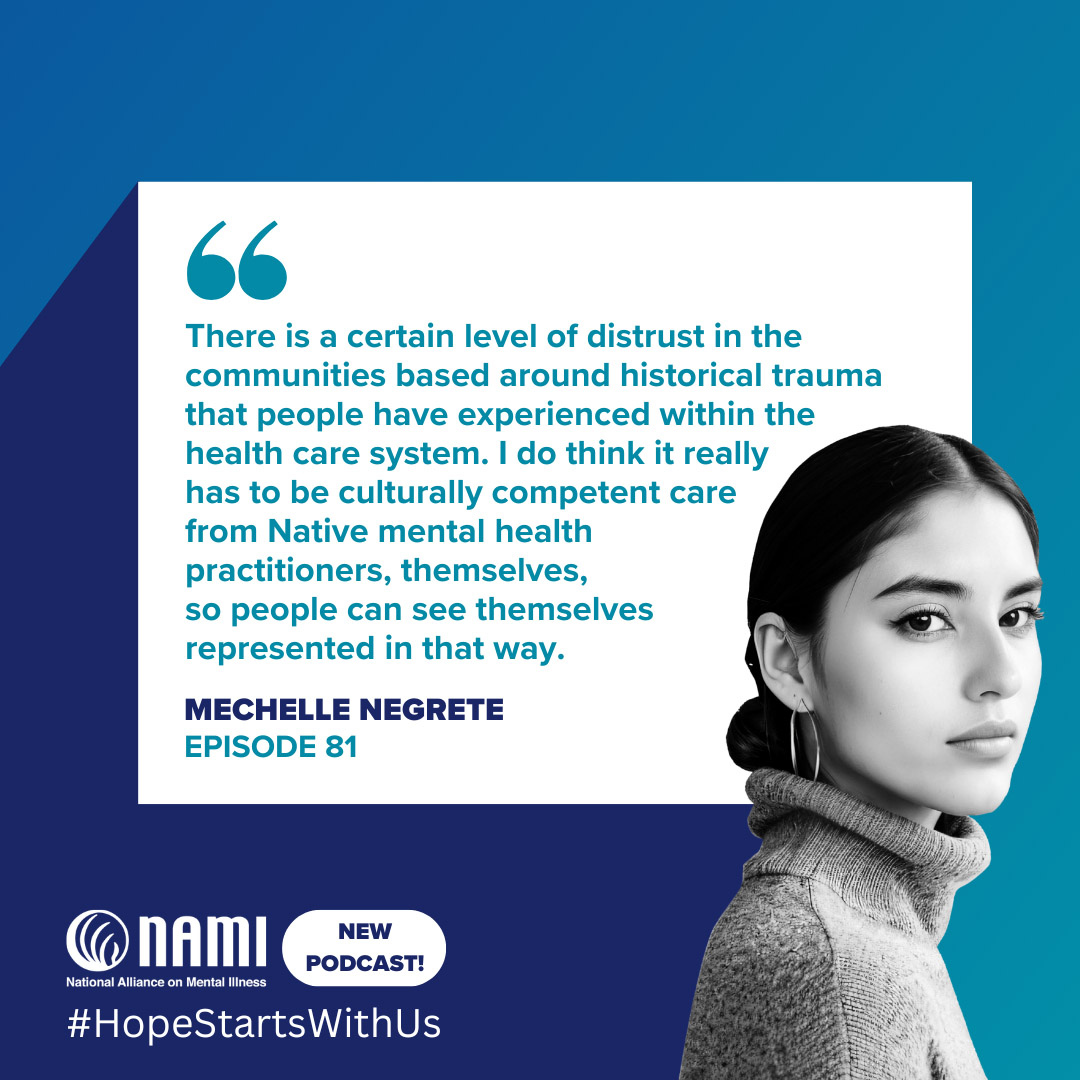
Nearly one-fifth of Native people experience a mental health crisis or illness. There is a certain level of distrust in the communities based around historical trauma that people have experienced within the health care system. I do think it really has to be culturally competent care from Native mental health practitioners themselves, so people can see themselves represented in that way.
00:00:26:00 - 00:00:51:14
Stephanie
Welcome to Hope Starts With Us, a podcast by NAMI, the National Alliance on Mental Illness. I'm your guest host Stephanie Robertson. NAMI's director of mental health equity innovation. NAMI started this podcast because we believe that hope starts with us and this really focuses on five things. Hope starts with us talking about mental health. Hope starts with us making information accessible.
00:00:51:16 - 00:01:19:03
Stephanie
Hope starts with us providing resources and practical advice. Hope starts with us sharing our stories. And hope starts with us breaking the stigma. If you or a loved one is struggling with a mental health condition and have been looking for hope, we made this podcast for you. Hope starts with all of us. Hope is a collective. We hope that each episode with each conversation brings you into that collective
00:01:19:03 - 00:01:44:08
Stephanie
so you know you are not alone. Again, my name is Stephanie Robertson and I'm the Director of Mental Health Equity Innovation here at NAMI. I lead the Community Health Equity Alliance, or CHIA, a community based-initiative focused on improving access to care for people with serious mental illness in minoritized communities. On today's episode, we will focus on mental health access and care in American Indian communities.
00:01:44:10 - 00:02:08:09
Stephanie
This Saturday, August 9th, is the International Day of World's Indigenous Peoples. And so, in honor of this day, we are speaking with an amazing guest. We have Mechelle Negrete, NAMI's manager of American Indian Mental Health Community Outreach. So as we get started today, I'm hoping you can share with us some of your mental health story. What experiences helped you become a mental health advocate?
00:02:08:11 - 00:02:40:04
Mechelle
Yeah. Thanks, Stephanie. So I always say my journey into mental health advocacy started in the community. Definitely growing up, you know, saw firsthand how much people were carrying, whether that was like, generational trauma, injustice, or just everyday stressors that kind of went unseen and untreated. You know, saw friends lose battles with depression and saw others overcome it.
00:02:40:06 - 00:03:15:07
Mechelle
I also had my own mental health journey with managing my anxiety and getting help with OCD-related anxiety as well. But it definitely--yeah, I realized that sharing stories and talking about it kind of helped me realize my own kind of stuff that I had going on, but then also that I wasn't alone in some of the things that I was experiencing, because I was like, oh, you think that way too?
00:03:15:09 - 00:03:20:01
Mechelle
That's cool. Let's talk about it. Felt less isolating for sure.
00:03:20:03 - 00:03:25:15
Stephanie
And then that's how you decided or began to think about becoming a mental health advocate?
00:03:25:17 - 00:03:54:11
Mechelle
Yeah. Kind of making that realization of my own. And then working with Native communities in my own community, I used to do language documentation and revitalization. That's kind of what my academic background is and is in linguistics. But I saw the direct impact on when people were reconnected with their culture, how it just kind of uplifted the whole community.
00:03:54:13 - 00:03:57:12
Mechelle
So definitely that combo too.
00:03:57:14 - 00:04:19:01
Stephanie
And I really do appreciate you sharing that and sharing your story in general. I have a similar kind of reason that I'm in this work is I began to share my story and saw that I was not alone, but that it helped others as well. And I think the power of storytelling is something that we underestimate sometimes.
00:04:19:03 - 00:04:40:23
Stephanie
But it really does mean a lot to others when they know that they're not the only one. And that there's someone else that can relate to them and can really connect with them. So again, thank you for sharing your story. Let's talk about your role at NAMI as Manager of American Indian Mental Health Community Outreach. So it's a newer role and part of the Cross-Cultural Innovation and Engagement team.
00:04:41:01 - 00:04:45:14
Stephanie
What have you done this last year and what are you most looking forward to doing in this role?
00:04:45:19 - 00:05:15:21
Mechelle
Yes, I'm incredibly honored to be on the CCIE team. Essentially, I am expanding the Sharing Hope series. It's a series that was created in direct response to George Floyd and all of the Black Lives Matter Movement that was happening during COVID. And to my understanding, NAMI already worked with these communities, but this kind of really formalized it.
00:05:15:23 - 00:05:52:05
Mechelle
And so it's just, a series that's for and about marginalized communities. And so they brought on me to expand into the Native American Indigenous groups. And yeah, so I've really just been building that out using a similar framework, but making it culturally competent to our specific community. And it's been really rewarding. And I have been so excited to-- because I am a Mescalero Apache.
00:05:52:05 - 00:06:37:15
Mechelle
So my family is from Albuquerque, New Mexico kind of region. The Mescalero Reservation is south of Albuquerque, but it's the closest, like, major city to it. And then I've worked with a lot of like California, Southern California, Natives. And so my experience definitely is like the Western Native culture. So I'm really excited in this position, it being national, to learn about other Native communities, like Pacific Northwest or I was just up in North Dakota with the MHA Nation, and they're doing incredible work up there.
00:06:37:17 - 00:06:55:22
Mechelle
So, yeah, so it's been really good to see how other cultures, because even though we are all Native within our culture, it's like all these subgroups, of course, that have their own way of healing and connecting. And so it's been a really good learning opportunity for me, also.
00:06:56:00 - 00:07:13:18
Stephanie
And would you be able to maybe break down what Sharing Hope is or what it is-- what you will be doing like what does this comprise of? Is it just a conversation or is it several conversations? So just what does it look like for those who may not know much about it?
00:07:13:20 - 00:07:46:15
Mechelle
Definitely. So the Sharing Hope series is a three-part community conversation series. So the first conversation, you kind of get acquainted with everyone. It's a video led discussion series. So we watch videos about Native mental health and then you have conversations about them afterwards. The second conversation, we bring in a Native mental health practitioner and they give kind of a presentation and go over Q&As and kind of help break--
00:07:46:15 - 00:08:12:00
Mechelle
That's a big part of the breaking the stigma of that. And then the third one, we talk about signs and symptoms of mental health, what it really means to be well in our communities, what that looks like, and also create a mental fitness plan so that we can help ourselves through our day to day lives, stay healthy.
00:08:12:02 - 00:08:41:19
Stephanie
And, so I've worked a little bit with the office, the CCIE office and Don Brown, phenomenal leader who does Sharing Hope with Black African ancestry communities. And so that is a lot of the work I do with the Community Health Equity Alliance. And being able to really break that stigma, that stigma does exist in numerous, you know, communities, but really being able to focus on why that stigma exists in certain communities and how to best approach it.
00:08:41:21 - 00:09:05:15
Stephanie
I think it's amazing that your office, this office, is doing that and that this is an initiative that the NAMI cares deeply about. So I'm going to switch gears a little bit and I want to talk some data here. In 2019, there are stats that showed nearly one-fifth of American and Indian indigenous people in the US experienced a mental illness.
00:09:05:17 - 00:09:17:01
Stephanie
Could you share some barriers to mental health care for American Indian communities? And what do you believe are the biggest reasons for these rates of mental health conditions in these communities?
00:09:17:03 - 00:09:56:08
Mechelle
Yeah. So that 2019 statistic, yeah, nearly one-fifth of Native people experience a mental health crisis or illness. That's a significant number. And it is likely underreported. And it is possible that it's higher now, specifically post COVID where a lot of our communities were heavily affected. But I believe the biggest barrier is just access. A lot of folks are on rural or remote areas where there are few, if any, mental health professionals.
00:09:56:10 - 00:10:22:17
Mechelle
And then if there are, you know, some of these places are huge. And just getting to that care via transportation can be can be a big barrier as well. Even if you're trying to do it virtually, Zoom, internet access is spotty on reservations a lot of the times. And then if you do get care, there can be long wait times.
00:10:22:19 - 00:10:46:20
Mechelle
That can make it nearly impossible for it to be consistent. And then there is also a level of distrust in the health care systems. Just from historical trauma, colonization, forced removal, the boarding schools. So a lot of that can dissuade people from seeking help just in general.
00:10:46:22 - 00:11:15:11
Stephanie
So what type of, help or resources do you think would be available? Especially if we're talking about younger populations, because one of our focus at NAMI is really how do we make mental health care more accessible? And we know that getting folks help earlier is the key. And if you can speak a little bit to that as well, in the context of what you just said, that literally, it's hard for everybody to get it.
00:11:15:11 - 00:11:27:08
Stephanie
It's like, are there initiatives? Are there things that you are working on, that organizations are working on to make this more accessible to all? But specifically for this question, young people.
00:11:27:09 - 00:12:17:19
Mechelle
Yeah, I do think it really has to be culturally competent care, you know, from Native mental health practitioners themselves so people can see themselves represented in that way. And then also just having other outlets rather than going down paths that typically lead to substance misuse or, you know, other poor forms of coping, such as, again, I just mentioned that I was up at the MHA nation and there's a gentleman up there that is doing this youth sports program and it's things like that, just extracurricular activities where you can be part of a team and help each other in other ways
00:12:17:19 - 00:12:24:06
Mechelle
than, you know, kind of staying within the cycle of trauma.
00:12:24:08 - 00:12:49:23
Stephanie
And I've heard other guests say that as well, as being able to provide spaces for sports or for music and art is really helpful, especially if maybe access to immediate mental health care isn't there. And more of a proactive piece of this as well is, how do we get you involved in different things in order to help you?
00:12:50:01 - 00:13:05:00
Stephanie
Because, yeah, I've heard that, for a number of times, I definitely was not a sports person. I was the band person, but that helped me a lot. So what changes do you hope to see surrounding mental health care? What do you believe would make the biggest impact?
00:13:05:02 - 00:13:40:08
Mechelle
Yeah, I hope to see a shift from instead of just being treated, you know, one that kind of listens and invests and partners. I think that's going to be the biggest thing is partnering long term with community-led and culturally grounded, like, grassroots organizations. So I believe that means supporting tribal nations and Native organizations to design and deliver care in a way that aligns with their specific values.
00:13:40:10 - 00:14:09:13
Mechelle
Because I feel like they already have the wisdom, you know, we just need resources to lead and carry that out. So, yeah, funding that prioritizes Native voices in a long term way, not just like individual grants here and there, but real sustained partnerships. That can build trust and have built the capacity within our own nations.
00:14:09:15 - 00:14:25:22
Stephanie
Do you feel that the Sharing Hope series is the beginning of this is, it's something that really does lift voices and center the voices that you're speaking of and help with that partnership--help build that partnership?
00:14:26:00 - 00:14:55:16
Mechelle
Yeah, I absolutely do. It's an incredible framework where we create all of these resources and guides and basically give them to the community and train people in the community to then facilitate those conversations themselves. And so it really is getting in there on the ground and helping people with the grassroots work that they were already doing.
00:14:55:18 - 00:15:21:03
Mechelle
So yeah, I really do believe that it is a step in the right direction. Especially because, Sacred Circle and the Sharing Hope series is meant to be a stepping stone. It is like your initial conversation. It's very low stress. It's low stakes. We're just getting together and talking with your community members, just having a chat.
00:15:21:05 - 00:15:25:19
Mechelle
So yeah, I absolutely think that is--this is the correct step.
00:15:25:20 - 00:15:55:23
Stephanie
Love to hear that. And I know working with your office that the next step could be and is going to be, you know, this-- the Community Health Equity Alliance is an example of a next step where, you know, communities who, or individuals and those who are supporting individuals who do have a serious mental illness, can seek out resources and help-- and we help with, you know, getting access to care as well.
00:15:55:23 - 00:16:19:16
Stephanie
So I think NAMI is great about starting these partnerships and then making sure that there are different initiatives within the organization that can continue them. So that's the goal. And we're working toward it. And I think I think we're going to be able to do it because it's important work. And being able to have a framework that can be applied to different communities.
00:16:19:18 - 00:16:49:22
Stephanie
To really meet them where they are is, as you said, is going to be really, really important. And we're working on it. So the CDC reported some really alarming statistics which show that the suicide rate among American Indian Alaskan Native populations were about 50% higher than non-Hispanic whites. How can we help lower this number? What programs or initiatives do you know about that are currently trying to lower this number?
00:16:50:00 - 00:17:21:23
Mechelle
Yeah, that number is extremely alarming and unfortunate. I think that again, getting the culturally competent care, getting more resources to reservations, and one of those things that's currently happening right now is Tribal 988. It's specific-- 988 specifically for Tribal Nations. I believe the state of Washington is the only state in the US that currently has that active.
00:17:22:01 - 00:17:47:12
Mechelle
But last year, I had the opportunity to go to the California 988-- Tribal 988 Conference. And so there's a lot of work pushing for that in California right now. And it's essentially just so that you can be connected with people who are either Native themselves or who are aware of, you know, Native culture and traditions.
00:17:47:17 - 00:18:16:10
Mechelle
A story that was shared with me once where someone was asking for help and they said that they were talking with their ancestor and all of this stuff that is very normal in Native culture. And the person that they were working with reported them for schizophrenia. And so it's things like that where we do need that specific care for Native folks.
00:18:16:12 - 00:18:39:21
Mechelle
And so Tribal 988 is basically doing that. You can call in a crisis and they're not going to if you say something like that, you know, they might not immediately think that you're unwell and in that specific way. And so the Tribal 988 Conference is happening again in California in September. We are going to get to table that on behalf of NAMI and make those connections there as well.
00:18:39:21 - 00:18:53:05
Mechelle
So I'm excited to go there and learn how we can better help push that forward. So I think getting that across the U.S. is going to be a really, really helpful resource.
00:18:53:07 - 00:19:23:03
Stephanie
I completely agree. And it's amazing that it exists, but it is disappointing that it exists in one and hopefully two, you know, two different states soon. And for those of you who are listening and want to see what's happening in your own state and whether you can help, can you talk about the conference a little bit more, maybe the date, and so people can just kind of look that up and look more into how they can look at their state to see what they're doing and how they can help.
00:19:23:05 - 00:19:49:13
Mechelle
Yeah. So this year, Tribal 988 Conference in California will be happening September 8th and ninth. It's two days this year. And it is in Southern California. It's at the Pala Casino and Event Center in Pala, California. So that's going to be a fantastic day of learning. Last year it was really emotional, but also really rewarding at the same time.
00:19:49:15 - 00:20:04:18
Mechelle
And then, yeah, if you are interested in what's going on in your state, all you have to do is Tribal 988 in your state, whatever state you're in. And you can probably see the current status of efforts in your area.
00:20:04:20 - 00:20:28:00
Stephanie
Thank you so much for sharing that. So before we conclude, I'd like to ask you a question we ask every podcast guest. The world can be a difficult place, and sometimes it can be hard to hold on to hope. That's why each episode we dedicate the last couple of minutes of our podcast to a special segment called Hold On to Hope.
00:20:28:01 - 00:20:33:13
Stephanie
Can you tell the audience what helps you hold on to hope?
00:20:33:15 - 00:21:00:05
Mechelle
Yeah, that's a beautiful question. I think that what helps me hold on to hope is traveling to these different nations and talking to people, and everyone is very excited. Like, I know that stigma has been a thing. I've experienced it. But the people that I'm meeting and talking to, it really seems like that it's finally starting to change.
00:21:00:07 - 00:21:28:04
Mechelle
And it comes from a lot of elders too where I'm seeing this positive feedback and really, elders hold the wisdom of our communities in a lot of communities. And so to see them being so accepting and interested and passionate still is really helpful because I feel like then they can pass down information and we can start to see a real change.
00:21:28:06 - 00:21:48:20
Stephanie
I love to hear that. I do believe that conversations have become more open and more frequent, but to hear that part as well as the elders being open to and wanting to pass on, was wisdom is phenomenal. So that definitely is something that would give me hope as well. So thank you for sharing that.
00:21:48:22 - 00:22:05:17
Mechelle
Yeah, definitely. And then for me personally, just on a day to day basis, you know, my dog gives me a lot of hope just throughout the day. I love taking her on walks and I play music as well. So I definitely feel through that. So yeah.
00:22:05:19 - 00:22:32:10
Stephanie
Thank you for sharing that as well. I think that's important to be-- what everyday things can give you hope, too. A run gives me everyday hope. You know, getting up early in the morning where it's just super quiet and I'm able to just take that time to myself. So being able to talk about the things every day that we are looking forward to or that give us hope as well, is just as important as the longer, you know, bigger kind of term goals that we all have.
00:22:32:15 - 00:22:54:18
Stephanie
So I want to thank you. And you know this-- you're doing amazing work, and it has been a pleasure to speak to you a little bit about it. I hope conversations like this continue to open doors for more meaningful conversations. And as we close this episode, I also hope we recognize that this is more than a day of awareness.
00:22:54:18 - 00:23:16:04
Stephanie
It's a call to action to advance equity in mental health care for American Indian communities and other marginalized communities, and really to keep pushing for access to culturally responsive care for all. This has been Hope Starts With Us, a podcast by NAMI, the National Alliance on Mental Illness. If you're looking for mental health resources, you are not alone.
00:23:16:06 - 00:23:54:05
Stephanie
To connect with the NAMI helpline and find local resources, visit NAMI.org/help or text "helpline" to 626420 or dial 800-950-NAMI (6264). Or if you are experiencing an immediate suicide, substance use, or mental health crisis, please call or text 988 to speak with a trained support specialist or visit 988lifeline.org. I'm Stephanie Robertson, your guest host for today, and thank you for listening.
00:23:54:07 - 00:23:55:05
Stephanie
Be well, please.
NAMI HelpLine is available M-F, 10 a.m. – 10 p.m. ET. Call 800-950-6264,
text “NAMI” to 62640, or email. In a crisis, call or text 988 (24/7).