Refine by
388 results found
-
NAMI Provides Testimony to U.S. Senate Judiciary Committee on Extreme Risk Protection Orders
Ron Honberg, NAMI’s senior policy advisor, testified in front of the U.S. Senate Judiciary Committee regarding Extreme Risk Protection Orders (ERPOs). He emphasized that criteria for ERPOs should be based on specific, real-time behaviors and evidence-based risk factors for violence rather than targeting people with mental illness. -
When A New Job Became My Worst Nightmare
"Three months after my hospitalizations, I got my overdue six-month review. The director cataloged every mistake I ever made so that my four-page evaluation read like an attack. I was demoted, pushed to the back of the office and stripped of my previous responsibilities." -
When Discrimination Starts in Elementary School
"The principal said that something had to be done about my son because 'he’s simply too dangerous and needs to be put in another environment.' My son was six years old at the time." -
Don’t Assume I’m Violent Because I Have Mental Illness
"They arranged a mandatory emergency staff meeting where they informed my colleagues that they felt I might be a violent threat to the office. They even had a picture of me placed at the front desk in the entrance of the building." -
My Brother is Not a Threat, He Has Schizophrenia
"Many times, I asked the police why they approached him. I was often told someone reported him as a 'suspicious person' lingering too long in one spot or that his appearance made some people uncomfortable, despite being in public spaces." -
When I Was Fired After Medical Leave
"Before I left on medical leave, I had taken on additional work to help a colleague whose husband was very ill and had been out for a few weeks, so I carried her caseload. Apparently, they have a different standard if you take leave because of mental illness." -
That Time in the Psych Ward
"My inpatient experiences traumatize me to this day. We need to focus on how it can be better, to turn psychiatric hospitalization into a constructive turning point towards recovery." -
It’s Not Stigma, It’s Discrimination
Often when we talk about stigma, we are actually talking about discrimination. We need to claim what people are experiencing as a civil and human rights issue and demand an end to discrimination.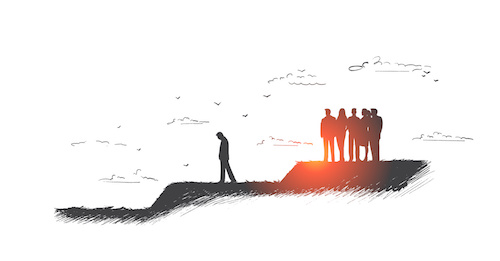
-
But I was a Victim, Right?
"I was twenty-two years old and in my last semester of undergraduate college when I suffered two psychotic breaks. During this time, I was unable to control my thoughts and behavior." -
Millennials and Mental Health
Millennials are more likely to talk about mental health than their parents or grandparents. And as more young people speak out, the stigma surrounding mental illness is beginning to lessen.