Refine by
244 results found
-
Register Today for a SAMHSA Webinar on Mental Health Crisis Settings
A SAMHSA sponsored webinar, “Psychiatric Advance Directives: Supporting Voice and Choice in Mental Health Crisis Settings” will take place Tuesday, May 21, 2019 at 2:00 p.m. EST.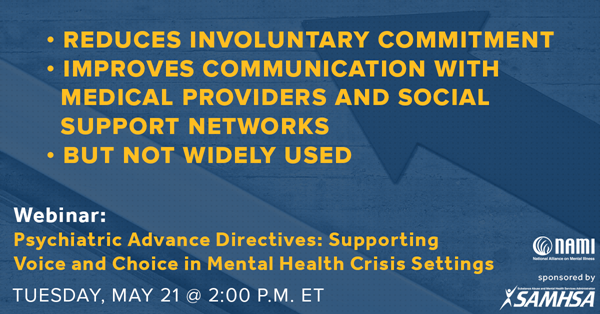
-
Gamers Champion Mental Health Awareness
RPG Limit Break is back again this Mental Health Month, speedrunning video games to raise awareness about mental illness and funds for NAMI. This event is what happens when we all band together for a common cause. -
Tidying for Your Mental Health
Here's advice on how to use the popular Marie Kondo method of tidying to improve your mental health. -
Therapy Concepts Everyone Needs to Know
Learning a few therapy concepts from Counseling 101 can empower you to reflect and make tangible changes to improve your mental health. Here are a few to get started. -
Shared Decision-making: Getting a Say in Your Care
Shared decision-making is when a person and their mental health care provider collaborate to create a treatment plan. Learn the benefits of this type of treatment. -
CBT for Psychosis: Approaches Families Can Use
As many as three in 100 people will have an episode of psychosis at some point in their lives. If you know somebody experiencing psychosis, using “CBT techniques” can help them. Here are a few to try. -
The Power of Emotion Education
Research has shown that burying emotions can lead to symptoms of mental illness. Learning how to safely process traumatic emotions is an important piece of reducing the growing trend of depression and suicide. -
NAMI’s Ask the Expert Webinar: Supporting a Loved One with Psychosis
This webinar explains how Cognitive Behavioral Therapy for psychosis (CBTp) can effectively support loved ones experiencing psychosis. CBTp is an evidence-based intervention recommended as a complementary treatment for psychosis. -
But I was a Victim, Right?
"I was twenty-two years old and in my last semester of undergraduate college when I suffered two psychotic breaks. During this time, I was unable to control my thoughts and behavior." -
Millennials and Mental Health
Millennials are more likely to talk about mental health than their parents or grandparents. And as more young people speak out, the stigma surrounding mental illness is beginning to lessen.